From Wastelands to Mines: Unlocking the 143% Phosphorus Circularity Potential in Global Waste Streams
Phosphorus recycling
20 April 2026 at 12:00
Phosphorus recycling
20 April 2026 at 12:00
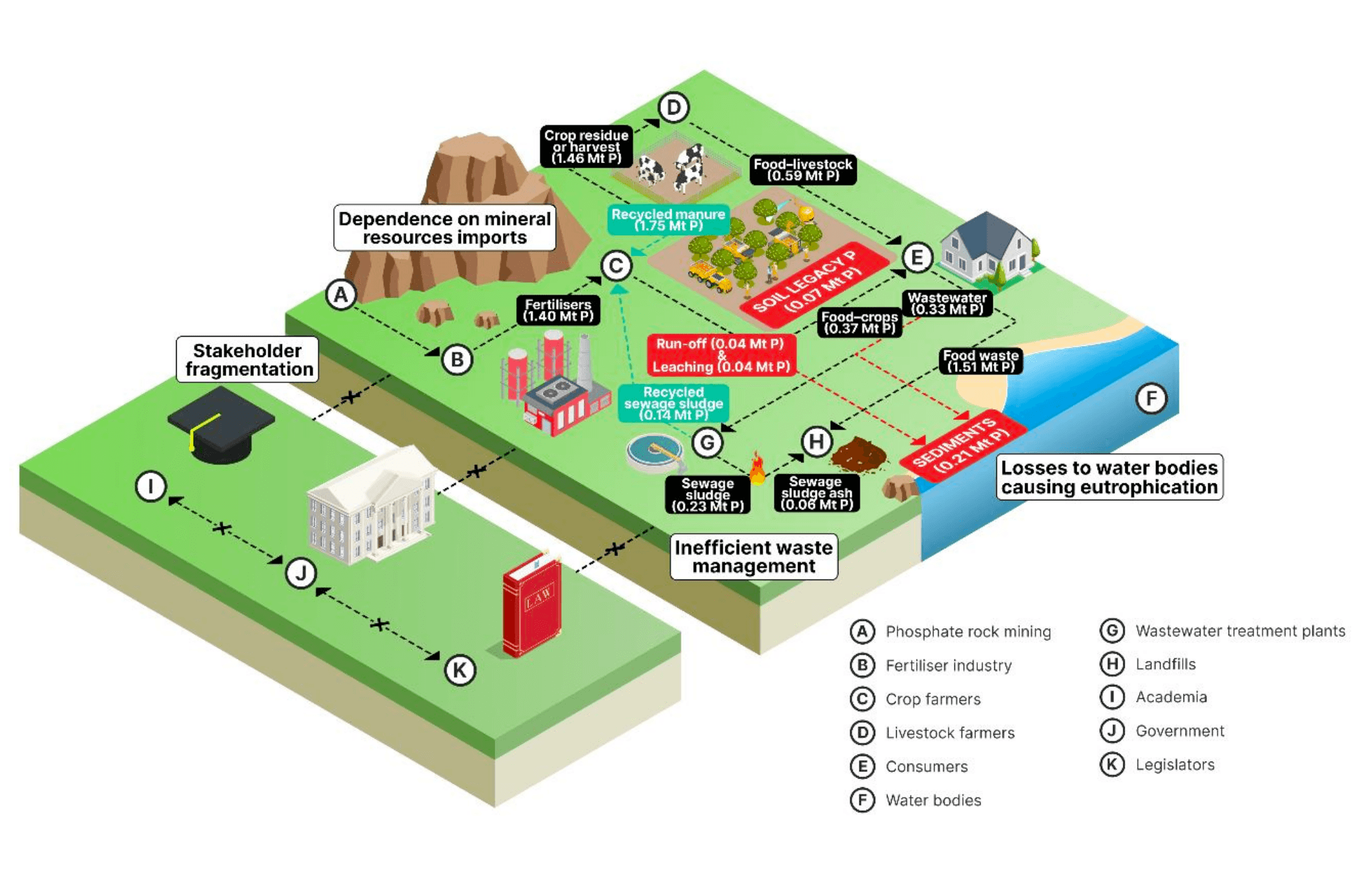
Global phosphorus management is currently mired in a "wicked problem" that inflicts approximately $265 billion in economic losses annually. As a critical strategic resource for global food security and industrial production, the prevailing linear management model has led to a profound systemic crisis. According to a recent synthesis published in Nature Reviews Earth & Environment, the annual global phosphorus demand stands at 26.5 million tons; however, due to inefficiencies, 80% to 95% of mined phosphorus is lost throughout its lifecycle. This extreme inefficiency not only accelerates environmental degradation through eutrophication but also signifies a fundamental fracture in the global phosphorus cycle. Given the high concentration of phosphate rock reserves and rising extraction costs, restructuring the phosphorus value chain has become a geopolitical and agricultural imperative.
Geopolitical vulnerability serves as the primary external driver for this transformation. Over 85% of global phosphate reserves are concentrated in just five nations, including Morocco and China. This radical asymmetry in resource distribution makes global phosphorus prices hypersensitive to geopolitical instability. Historical data indicates that political conflicts or trade barriers can cause fertilizer prices to surge manifold within short periods, threatening the stability of global food systems. To mitigate the risks associated with such dependency on primary imports, nations are increasingly focusing on diversifying phosphorus sources. Notably, the total phosphorus currently sequestered in global secondary resources—such as livestock manure, wastewater, and food waste—is equivalent to 143% of the current annual global demand, signaling a massive, untapped "invisible mine" awaiting technological unlocking.
In this resource-restructuring process, activating "Legacy Phosphorus" accumulated in soils and sediments represents the ultimate technological frontier for achieving a closed-loop system. Between 1965 and 2007, over 815 million tons of legacy phosphorus accumulated in global soils due to over-fertilization, while aquatic sediments hold an additional 2.68 billion tons. Although these reservoirs are vast, they exist in recalcitrant chemical forms that are largely unavailable to crops. Current scientific frontiers are focusing on activating these reserves through physical, chemical, and biological pathways. Examples include "bio-mining" using cover crops with high rhizosphere acidification and phosphatase secretion capabilities, or developing biostimulants that precisely restructure soil microbial communities to convert legacy phosphorus into bioavailable forms.
However, transforming secondary resources into high-efficiency fertilizers still faces stringent technical and economic barriers. Secondary phosphorus sources are highly heterogeneous and often carry risks from contaminants such as heavy metals, pathogens, and microplastics. To balance recovery efficiency with agronomic safety, capital-intensive technologies like incineration, pyrolysis, and electrodialysis have entered full-scale demonstration phases in developed nations, but their production costs remain significantly higher than traditional mineral fertilizers. For instance, extracting phosphoric acid from sewage sludge ash can incur operating costs triple the current market price. This economic inversion, coupled with logistical challenges in cross-regional collection, means that the large-scale industrialization of phosphorus recovery still relies on interdisciplinary governance frameworks and policy incentives.
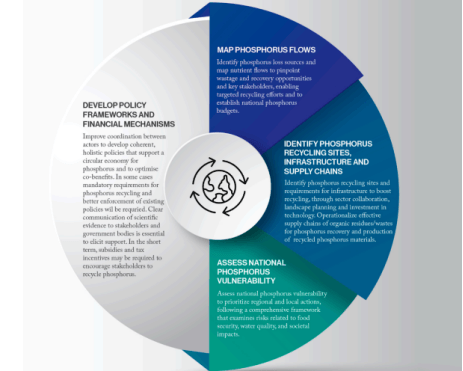
Ultimately, transforming global phosphorus management requires a multi-dimensional integration strategy that transcends mere technology. This involves the widespread adoption of precision agriculture, a shift in human dietary patterns toward low-phosphorus footprints, and a delicate balance between international trade rules and domestic regulatory mandates. By establishing cross-sectoral collaborative mechanisms and breaking down the information silos between academia, industry, and policymakers, it is possible to reshape the current linear phosphorus supply chain into a resilient circular system. In the future of global resource competition, nations that first decode the activation of legacy phosphorus and achieve efficient waste recovery will secure a more robust resource defense line and a more competitive sustainable agricultural landscape.
Source:Raniro, H. R., Serrano-Gomez, J., Mort, H. L., Kalpakchiev, T., Kooij, J., Zhao, Y., ... & Reitzel, K. (2025). Overcoming recycling barriers to transform global phosphorus management. Nature Reviews Earth & Environment, 1-18.





 贵公网安备52011502009966号