Challenging the "Abyssal Desert" Paradigm: An Invisible Phosphorus Reservoir Discovered at 6,000 Meters
Phosphorus recycling
20 April 2026 at 12:00
Phosphorus recycling
20 April 2026 at 12:00

In the traditional maps of marine science, deep-ocean basins exceeding 5,000 meters in depth have long been classified as "resource deserts." Due to their distance from continental margins and extremely low primary productivity, phosphorus—a critical element for sustaining life and ocean fertility—was thought to be nearly impossible to sequester in significant quantities within these regions. However, a study recently published in the Proceedings of the National Academy of Sciences (PNAS) by Professor Yuan Peng’s team from the Guangdong University of Technology, in collaboration with multiple institutions, has fundamentally overturned this long-standing perception. In the ultra-deep sediments of the Western Pacific at depths below 6,000 meters, Chinese scientists have identified a novel mechanism for authigenic phosphorus burial, revealing a "global deep-sea phosphorus reservoir" that has been systematically underestimated.
As a limiting nutrient for marine ecosystems, the burial process of phosphorus is directly linked to the global carbon cycle and ecological equilibrium. For decades, scientists struggled to explain how phosphorus could be effectively retained in sediments within deep-sea environments characterized by extreme organic matter scarcity and highly oxygenated bottom waters. Through micro-analytical investigation of sediment samples from the East Mariana Basin and the Philippine Sea, the research team identified a specific authigenic mineral: carbonate fluorapatite. The study confirms that this mineral does not form in isolation but exists in a tight symbiotic relationship with phillipsite, a mineral abundant in the deep sea. The release of calcium ions from phillipsite induces the precipitation of phosphate from pore waters. This unique mineral-interface interaction enables the highly efficient accumulation of phosphorus even in environments with extremely low nutrient concentrations.
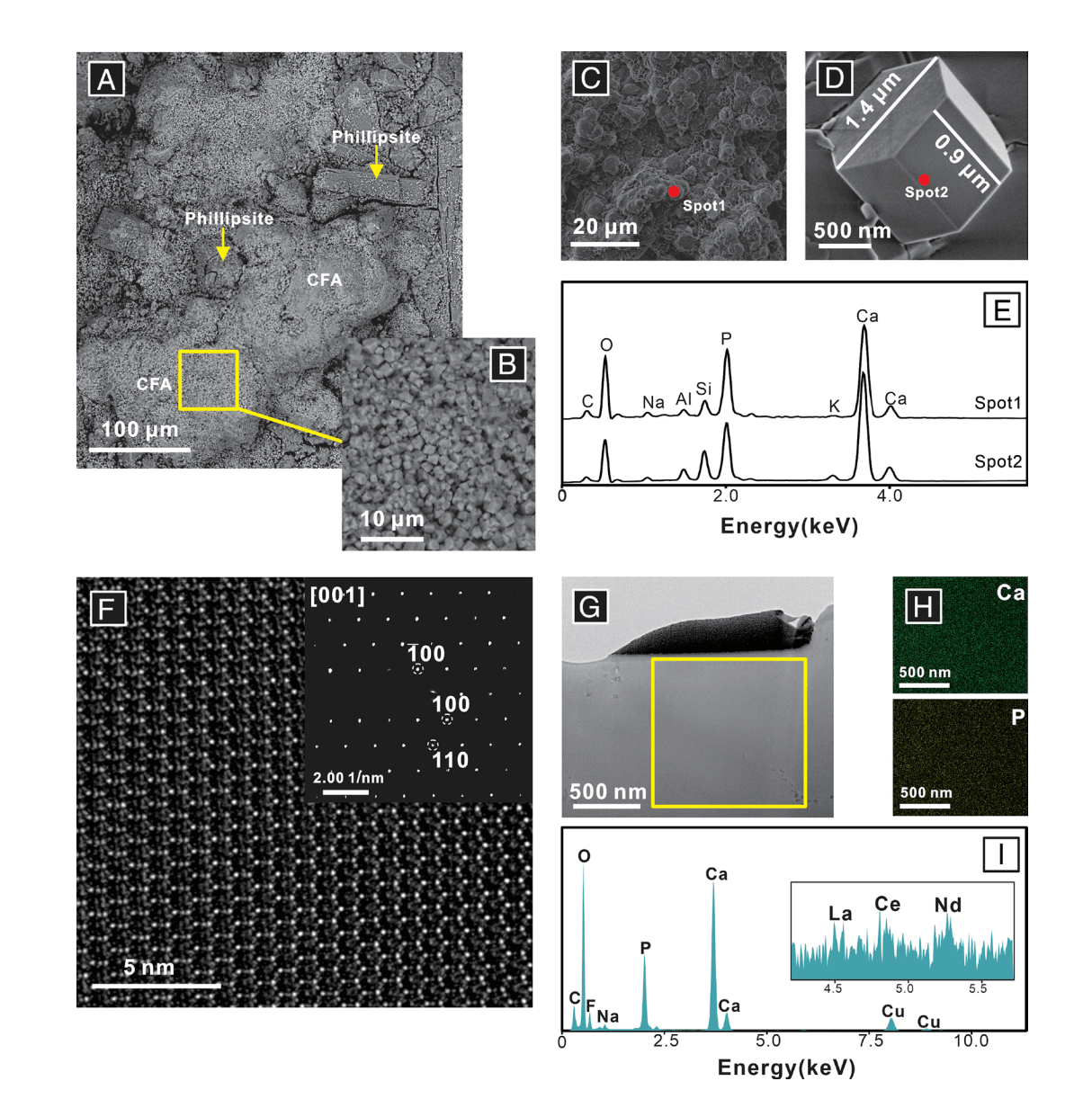
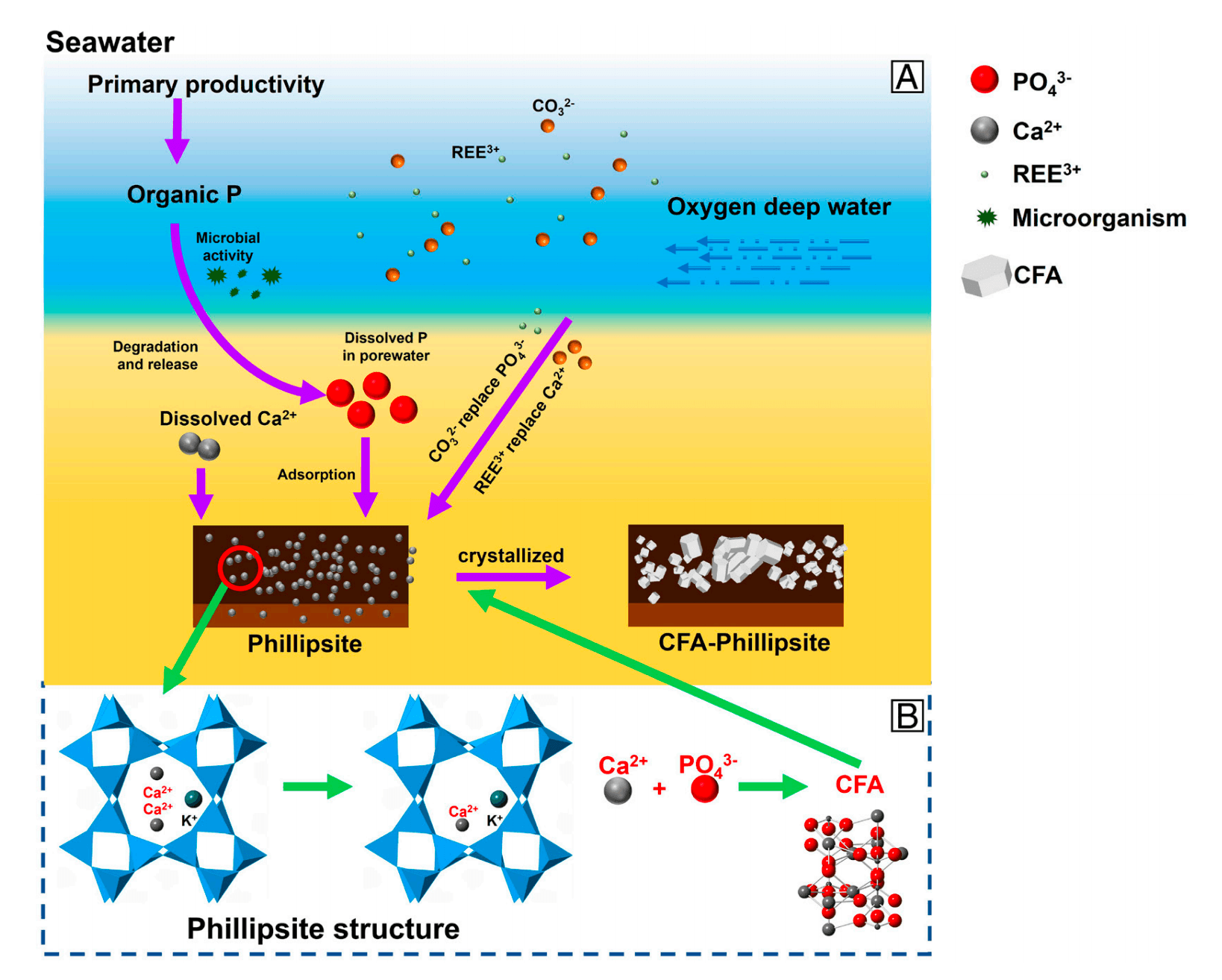
Figure 1 (Left). Morphology, structure, and element composition of CFA coating phillipsite. (A and B) Phillipsite covered by abundant finely crystalline CFA, scanning electron microscope (SEM) images. (C) Poorly crystalline CFA grains on phillipsite; SEM image. (D) Single CFA crystal; SEM image. (E) Energy-dispersive X-ray spectroscopy (EDS) patterns of CFA. (F) [001] zone axis image and selected area electron diffraction (SAED) pattern of CFA after focused ion beam (FIB) preparation. (G and H) Transmission electron microscopy (TEM) mapping of the chosen area after FIB preparation. (I) EDS pattern of CFA including REE.
Figure 2 (Right). Scenario of CFA formation aided by phillipsite in deep-sea environments. (A) The calcium ions (Ca2+) derived from the structure of phillipsite and pore water combine with PO4 3− adsorbed on the surface of phillipsite, forming abundant CFA on the surface of phillipsite accompanied by cation substitution by REE (REE3+). (B)Formation mechanism; Ca2+ release from the micropores of phillipsite and subsequent formation of CFA on the surface of phillipsite.
The implications of this discovery extend far beyond mineralogy, providing a missing piece in the puzzle of the global marine material cycle. The burial mechanism of carbonate fluorapatite directly dictates the total amount of bioavailable phosphorus in the ocean, meaning that deep-sea basins actually function as a vital regulatory hub for global marine productivity. By sequestering phosphorus in the deep ocean, this process regulates the efficiency of the global biological pump, thereby influencing the long-term concentration distribution of atmospheric carbon dioxide. Given that this mechanism is highly coupled with the widely distributed phillipsite, traditional global phosphorus cycle models and assessments of total marine phosphorus reservoirs may now require systematic revision.
From a strategic resource perspective, the potential demonstrated by this mineral possesses significant industrial weight. The research found that rare earth element (REE) concentrations within these deep-sea carbonate fluorapatite minerals reach as high as 1,200 ppm. In a strategic context, this means that carbonate fluorapatite is not only a circulatory center for marine nutrients but also a highly efficient sequestrator of strategic resources. By locking in large quantities of rare earth elements through structural coupling during its formation, this mineral serves as a precise indicator for the enrichment patterns of deep-sea REE resources. In future global strategic competitions over the deep sea, this "dual enrichment" mechanism of phosphorus and rare earths will provide the core scientific basis for China to evaluate deep-sea mineral potential and prioritize resource exploration.
By utilizing cutting-edge techniques such as high-resolution transmission electron microscopy, Professor Yuan Peng’s team has decoded the mineral symbiotic "cipher" at the atomic level, marking a significant contribution from China to the field of deep-sea environmental mineralogy. With the confirmation of this novel phosphorus burial mechanism, the global assessment of deep-sea resource reserves and their distribution patterns is poised for a comprehensive restructuring. In the coming era of deep-sea exploration, these microscopic crystals hidden 6,000 meters beneath the waves will serve as critical pillars for our understanding of planetary evolution and the safeguarding of national resource security.
Source:Fan W. X., Zhou J. M., Jiang X. D., Zhang H., Mi M., Yuan P., Dong Y. H., Liu D., Wei Y. F., Peckmann J.. Carbonate fluorapatite coatings on phillipsite represent a significant sink of phosphorus in abyssal plains of the western Pacific Ocean. Proceedings of the National Academy of Sciences of the United States of America, 2025, 122: e2407683122. DOI: https://doi.org/10.1073/pnas.2407683122.
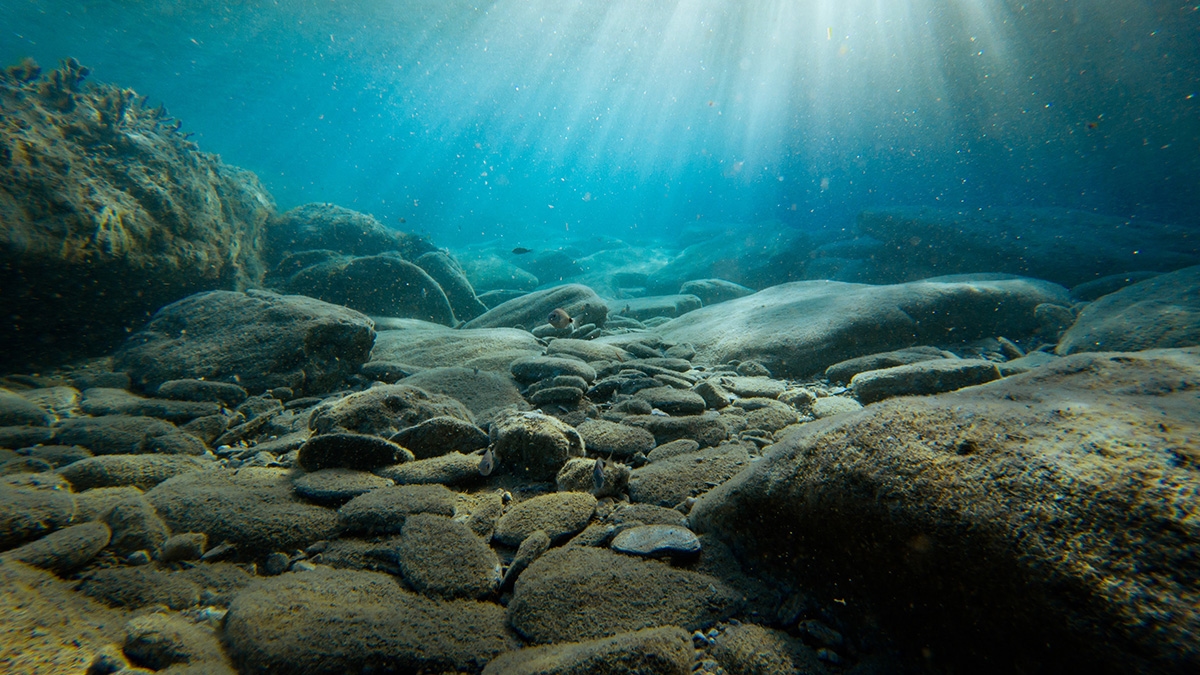
Lead image credit: Yannis Papanastasopoulos, Unsplash
 贵公网安备52011502009966号