Beyond the Smog: How "Atmospheric Phosphorous" is Redrawing Global Resource Maps
Phosphorus recycling
17 April 2026 at 12:00
Phosphorus recycling
17 April 2026 at 12:00
While the world celebrates the clearing of urban skies and the steady decline of particulate matter, a silent, invisible shift is occurring in the upper reaches of our atmosphere. Phosphorus—the "currency of life" and a critical strategic resource for global food security—is no longer just a substance found in mines or soil. It has taken to the skies.
A groundbreaking study recently published in Environmental Science & Technology by researchers from the Chinese Academy of Sciences and East China Normal University reveals a startling paradigm shift: Humanity has officially hijacked the global atmospheric phosphorus cycle.
For millennia, the movement of phosphorus through the air was a slow, natural process, largely driven by mineral dust hitching a ride on desert winds. Today, that narrative has been rewritten by industrial smokestacks.
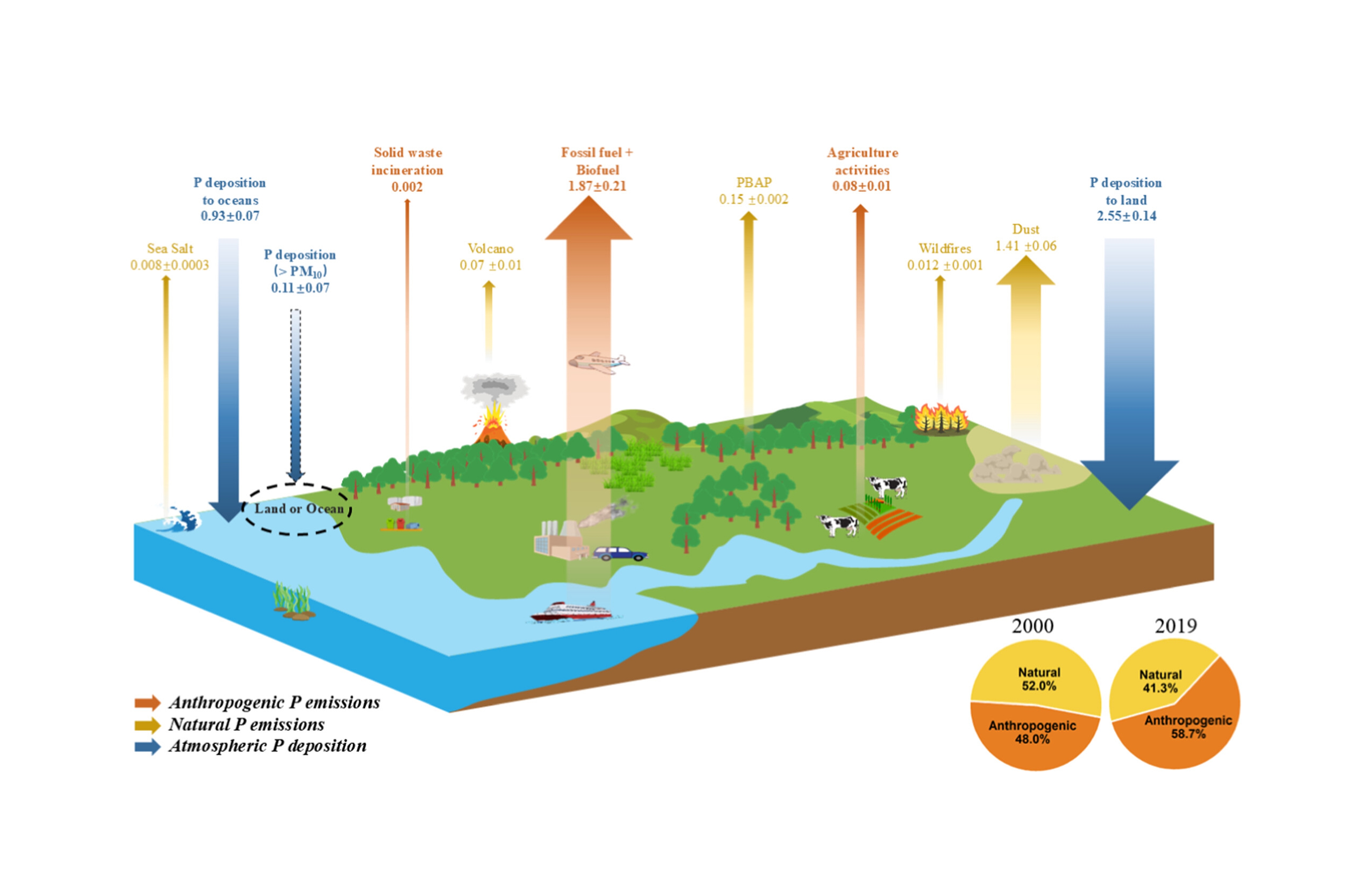
The research indicates that between 2000 and 2019, global terrestrial phosphorus deposition increased by 16.5%. More tellingly, the anthropogenic (human-caused) share of these emissions has surged to 56%. This marks a historic tipping point where human activity—specifically the combustion of fossil fuels and biomass—has surpassed natural sources as the primary driver of phosphorus in our atmosphere. We are, in essence, unintentionally "fertilizing" the entire planet from the clouds down.
Figure 1. Phosphorus (P) fluxes emitted to and deposited from the atmosphere.
Previously, tracking atmospheric phosphorus was like looking at a blurry, low-resolution photograph. Standard global models provided a coarse view that missed the nuances of industrial "hotspots."
The Chinese research team has solved this with a sophisticated "downscaling" algorithm based on spacetime mass conservation. By refining data from a 200km resolution to a sharp 0.1° (approximately 10km) scale, they have created a "High-Definition" map of global emissions. This technological leap allows us to pinpoint exactly where our strategic resources are leaking into the sky, transforming atmospheric phosphorus from a vague scientific estimate into a trackable, quantifiable asset.
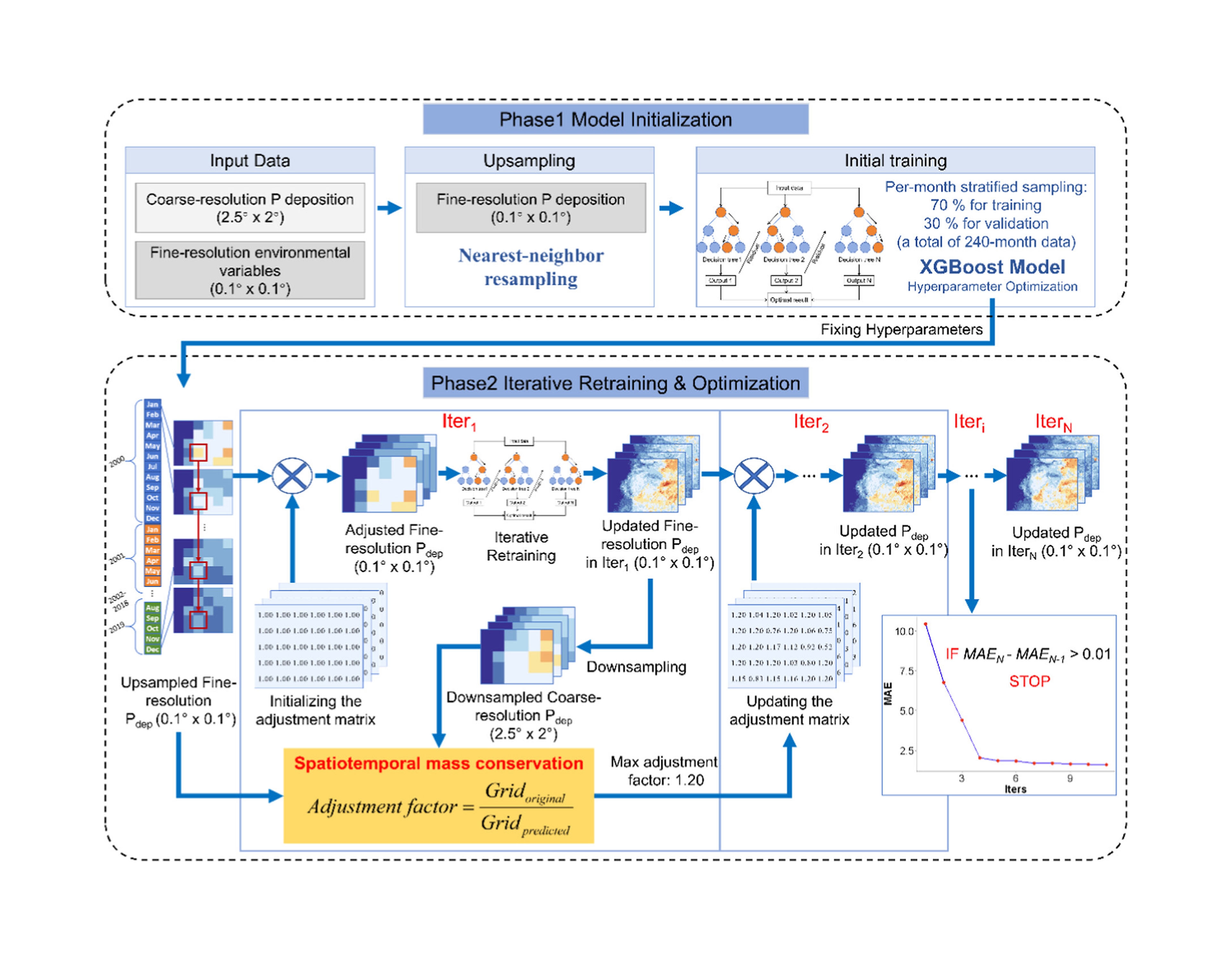
Figure 2. Framework of downscaling algorithm for monthly P deposition.
In this shifting landscape, China and India have emerged as the dominant players. Before 2013, China accounted for nearly 60% of the global increase in anthropogenic phosphorus emissions. However, following aggressive domestic air quality reforms, China’s emissions have stabilized. In contrast, India has seen a steady climb, reflecting its rapid industrial expansion.
For these emerging economies, this isn't just an environmental statistic—it is a matter of resource sovereignty. When massive quantities of phosphorus escape through industrial chimneys and settle in distant oceans or forests, it represents a "hidden leak" of a vital national resource that is essential for long-term agricultural stability.
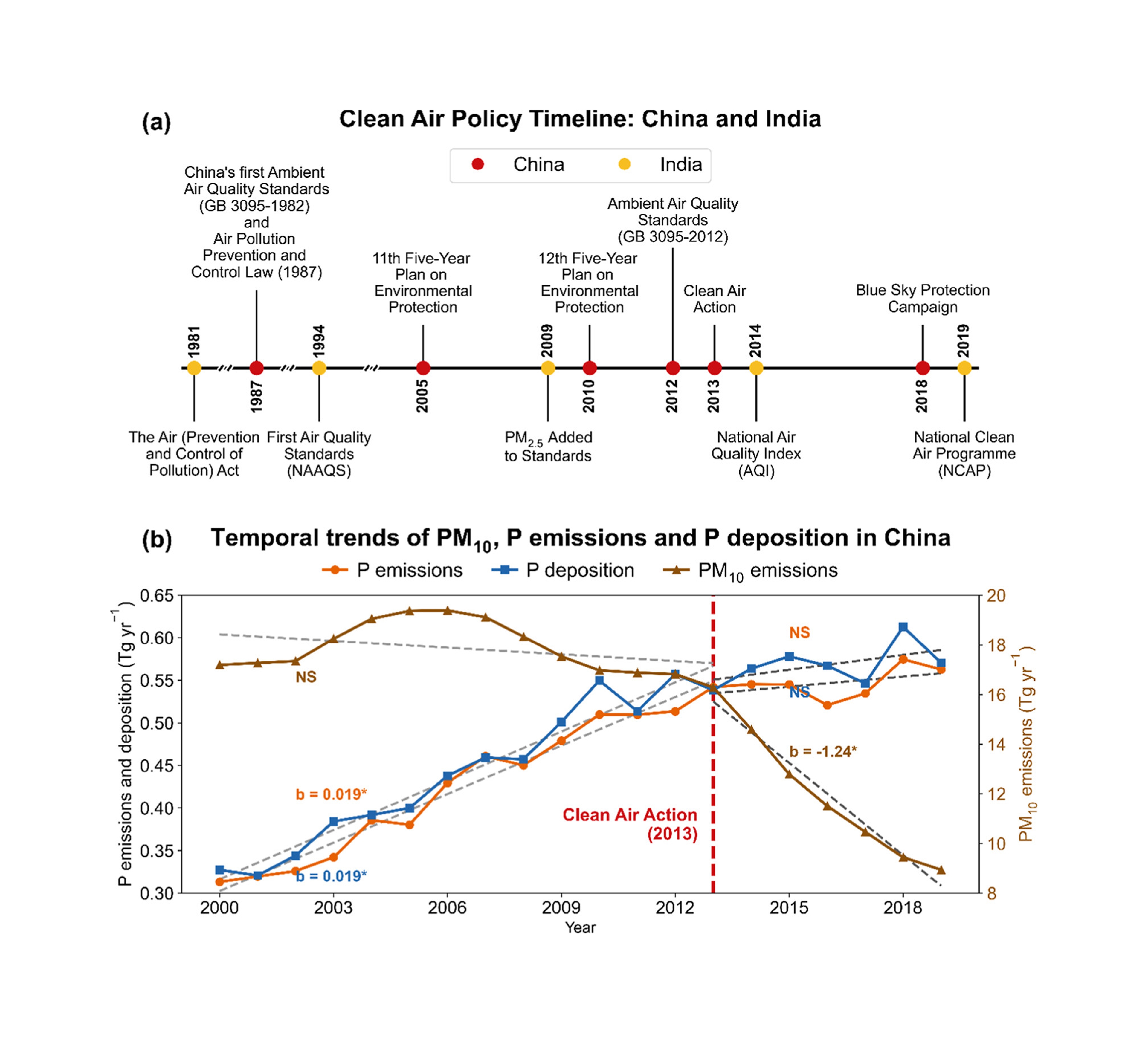
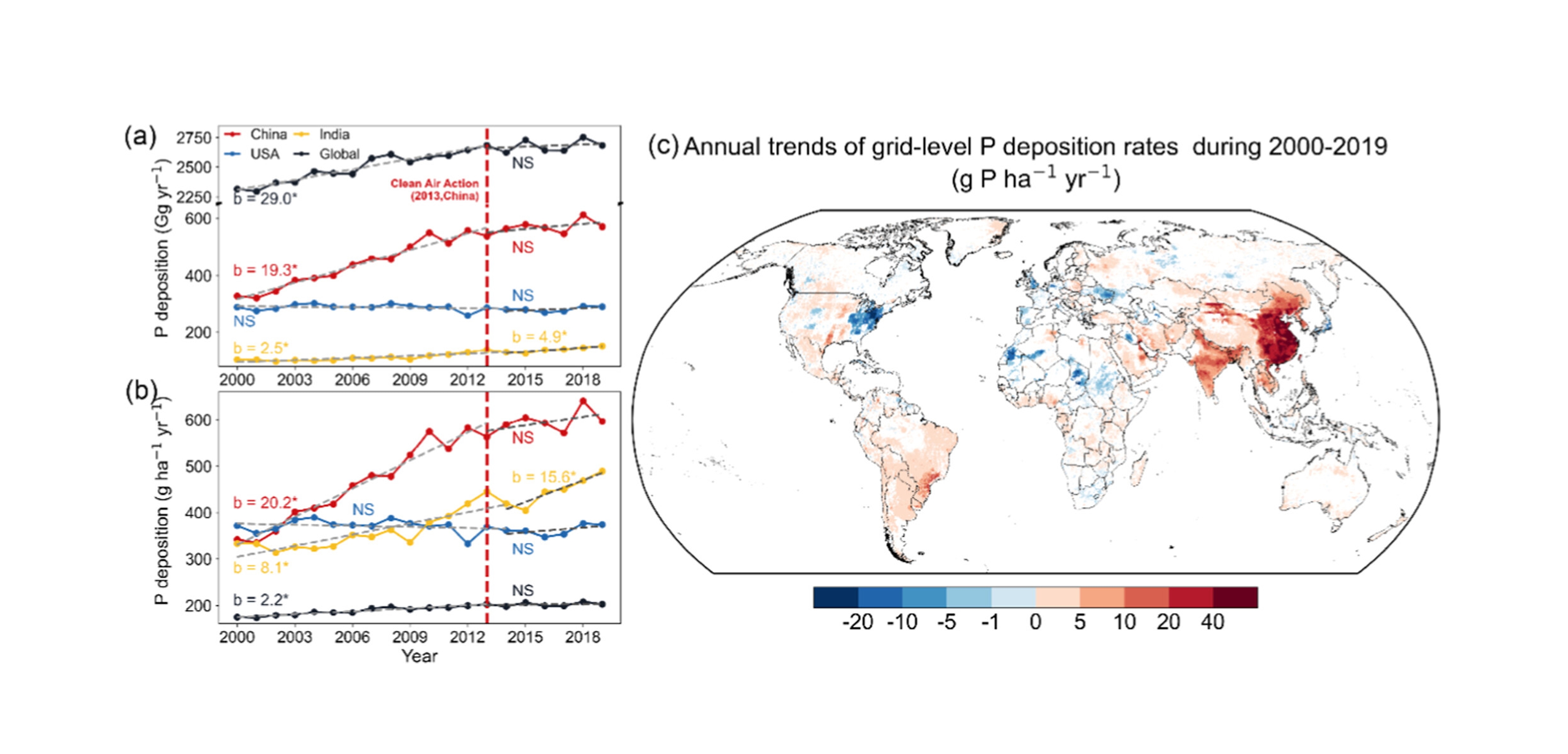
(left) Figure 3. (a) A timeline of major environmental legislation for clean air actions in China and India; (b) temporal trends of PM10, P emissions, and P deposition in China.
(right) Figure 4. Spatial and temporal changes in global phosphorus deposition.
This study serves as a sophisticated roadmap for the next evolution of environmental policy. It highlights that while current dust-removal technologies catch some phosphorus, the decline in phosphorus emissions is not keeping pace with the reduction of PM2.5.
We are entering a new era of "Precision Environmental Governance." The goal is shifting from simply clearing the air of visible pollution to the strategic management of vital nutrients. Establishing specific atmospheric phosphorus standards is the next logical step. It is about more than just ecological balance; it is about reclaiming the phosphorus that belongs in our circular economy rather than letting it drift away as industrial waste.
In the coming decades, the nations that master the "atmospheric-terrestrial" loop of phosphorus will be the ones that secure their place at the top of the global resource hierarchy.
Source:
You, S.; Ma, J.; Li, R.; Shi, H. Human Activities Dominate Global Trends in Terrestrial Phosphorus Deposition. Environmental Science & Technology, 2026, March 27. First authors: You Shiyu & Ma Jiageng (Chinese Academy of Sciences, Research Center for Eco-Environmental Sciences); Corresponding authors: Li Rui (East China Normal University) & Shi Hao (Chinese Academy of Sciences, Research Center for Eco-Environmental Sciences).